We’ve all scrolled past product shots that looked a little too perfect. The kind where you wonder: is this real, or is AI pulling a fast one on me? (In fact, I recently wrote about how to spot fake products online after being fooled myself.)
But here’s the truth: not all AI-generated imagery is bad. In fact, when it’s done thoughtfully, it can make the shopping experience clearer, easier, and more enjoyable. And here’s the part I get excited about: AI product imagery doesn’t just help Shoppers—it helps small businesses, too.
What Shoppers Really Need From Product Images
When you’re shopping online, you’re not just looking for a “pretty picture.” You’re trying to decide:
- What does it actually look like?
- How does it work?
- What does it look like in a setting?
- Will it fit into my life—or not?
That means product images need to do more than look nice. They need to:
- Show clarity – texture, color, finish, and scale that feel true-to-life.
- Provide context – lifestyle shots that help you imagine use (is that candle cozy on a nightstand, or bold enough for a centerpiece?).
- Stay consistent – uniform lighting and style so a store feels trustworthy.
- Spark connection – help you picture the product in your hands, not just on a white background.
When I’m reviewing new products at Grommet, these are exactly the questions I ask myself on behalf of Shoppers.
How AI Serves Shoppers and Small Businesses
Here’s where AI-generated imagery, done right, delivers value on both sides of the equation:
- Clarity and detail (for Shoppers): Zoom-ready visuals that show stitching, wood grain, or material texture—almost like holding it in your hand.
- Leveling the playing field (for Makers): Professional product photography is expensive. AI helps small businesses compete with bigger brands without compromising accuracy.
- Lifestyle context (for Shoppers): See a water bottle on a desk, in a hiking pack, or on a bedside table—without three separate photoshoots.
- Speed to market (for Makers + Shoppers): Makers can get products in front of Shoppers faster, and Shoppers see what’s new while it’s relevant.
- Consistency builds trust (for everyone): Whether it’s 10 products or 1,000, AI keeps lighting, shadows, and styling aligned so a store feels professional.
- Personalization possibilities (for Shoppers): Imagine clothing rendered on different body types, or furniture placed in a variety of room styles—helping you find your best fit.

Proof in the Real World
This isn’t just theory. Brands are already experimenting—and so are we at Grommet.
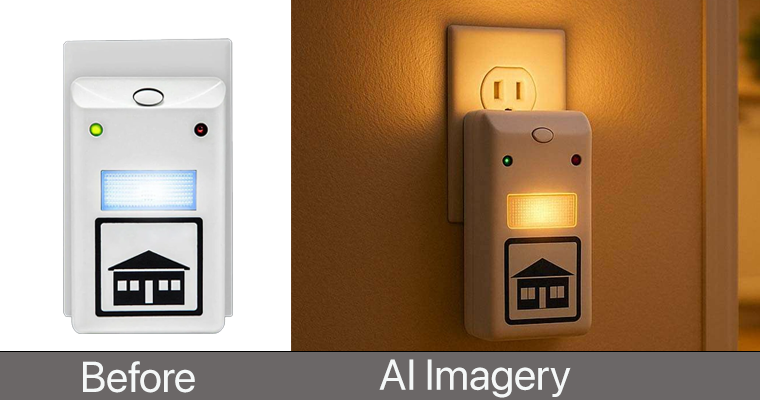
We’re using AI to enhance product imagery in ways that serve both sides of our marketplace. Shoppers get clearer, more contextual views of products. Makers get to showcase their creations in polished, lifestyle-ready scenes—without breaking their budget.
And to be clear: we never alter the products themselves. No exaggerations, no enhancements, no making something look like more than it is. Just better context for the real product you’ll receive.
The Transparency Factor of AI Product Imagery
Of course, none of this works without trust. If you read my first article on spotting fake or AI-generated products, you know how important honesty is in e-commerce.
That’s why the best use of AI imagery isn’t hidden—it’s an open conversation. At Grommet, that means being upfront and starting these types of conversations.
Our recent AI-enhanced product images don’t just look better—they’ve driven higher conversion rates on emails and product pages.
Everybody wins.
Wrapping It Up
Used well, AI doesn’t replace reality—it enhances it. It helps Shoppers see products clearly, and helps small businesses show up in ways they couldn’t before.
That’s the kind of innovation I believe in: making online shopping better, more human, and more meaningful—for both the people creating products, and the people bringing them home. Personally, I haven’t been this excited about showcasing products online in years—it feels like a real leap forward for both Shoppers and Makers.
✨ Curious—Shoppers: would you feel more confident shopping from a brand that clearly labeled which images were AI-generated? Or do you just care about getting the clarity you need to make a decision? I’d love to hear your thoughts.
Makers: Have you used AI to upgrade your product images? If not, what’s stopping you?

 Tori Tait is sharing her experience as a Content Director and Pinterest expert. Since 2006 she's been helping entrepreneurs build their businesses online through simple & smart marketing strategies.